Showing posts with label Acacia Research. Show all posts

Friday, March 30, 2012

Acacia Research ( Nasdaq - ACTG ) -- Raising Estimates

Acacia Research (ACTG $41.50) appears on track to produce booming Q1 results.  That trend could continue in subsequent quarters.  The company spent $160 million to acquire several patent portfolios (Adaptix) in the December period.  As part of that process Acacia negotiated substantial licensing deals with Microsoft and Samsung, which were consummated the first week of January.  Acacia had previously signed "structured contracts" with both companies, umbrella deals that provide access to a large amount of intellectual property that Acacia controls or might gain control of in the future.  The Adaptix patents fell outside of those protections.  In February Acacia announced that it already had generated licence income (revenue) of $75 million in Q1.  A large slug of that is believed to have come from the Adaptix deals.  Acacia hasn't signed any more Adaptix licenses since the Microsoft and Samsung contracts.  Those deals probably were arranged on friendly terms, in light of the companies' past relationships, future business opportunities, and the potential leverage the agreements created against other infringers.  Subsequent to the February announcement Acacia has delivered a drumbeat of additional deals, including a recent one with Amazon.  The company still hasn't gotten anywhere with Apple Computer.  That's the biggest infringer of them all, with billions of dollars on the table.  "You can run but you can't hide."  As they say.  Meantime, business is continuing to gain momentum.  New patent portfolios are being acquired.  A major acquisition is in the pipeline.  Competition is declining.  Infringement is increasing.  And large patent holders are becoming more active in trying to monetize their holdings.  Some of them will do it in-house but a growing number are kicking the tires to go partners with Acacia Research.

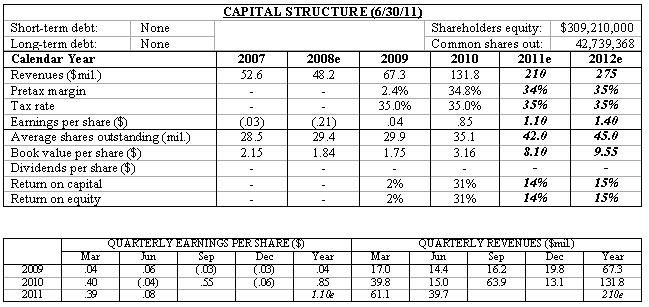
We are increasing our (fully taxed) 2012 earnings estimate from $1.25 a share to $1.50 a share.  Our revenue estimate also is going up, from $275 million to $325 million.  Neither reflects any contribution from the acquisition Acacia currently is working on, which might generate more firepower than the Adaptix deal.  The company completed a private placement in February to finance the acquisition.  Our earnings estimate includes that dilution but none of the prospective upside. 

The pace of patent acquisitions is accelerating.  Acacia pushed aggressively into the medical device area in 2011.  Recent diversification efforts include automobiles and energy.  In the past Acacia always was a little pressed for capital, so it insisted on 100% payments when infringers agreed to pay a license fee.  Now that liquidity is higher the company is starting to arrange payment terms, spreading out income over a period of time.  Acacia also is negotiating a higher percentage of deals without going to court.  That promises to smooth out quarterly revenue, as well.  Huge spikes are likely to persist, however.  Amplifying that trend is the likely re-focus by the company on "structured deals."  Acacia backed away from those arrangements last year as the intellectual property market took off.  The company didn't want to lock itself into deals that undervalued the intellectual property involved.  Now that valuations have stabilized a new round of structured deals could be in the cards. 

We estimate earnings will keep rising at a fast pace in 2013.  A larger patent portfolio combined with more out of court settlements, less competition, and more structured deals could propel (fully taxed) earnings to $2.25 a share.  Above average growth could be sustained well into the decade.

 ( Click on Table to Enlarge )

Thursday, January 26, 2012

Acacia Research (Nasdaq - ACTG) -- Acquisition Further Expands Patent Portfolio

Acacia Research (ACTG $40.50) remains on track to produce excellent on-target Q4 results. Acacia is the leading provider of intellectual property monetization services. The company collaborates with patent holders to settle IP disputes against infringing businesses. Acacia and its partners divide settlement proceeds.

Acacia acquired 230 new patents (in 13 countries) from its recent purchase of Adaptix Technology, a 4G LTE (“Long Term Evolution”, a high-speed wireless communications standard) technology developer, for $160 million. There are 15 “families” of patents within the portfolio, which cover many aspects of 4G and LTE technology. The company owns 100% of this patent portfolio, meaning it keeps all settlement winnings, minus costs for independent legal counsel. These outside firms typically retain 15%-20% of winnings when they are called in. Early licensing deals for the Adaptix patents have been completed with Microsoft and Samsung without litigation. Both companies entered into “structured settlements” with Acacia in 2010 and 2011, respectively, granting them use of Acacia’s entire portfolio for three years. Acacia has a similar agreement with Oracle, signed in 2010. The company has also asserted the Adaptix patents against AT&T, Motorola, and Nokia Siemens. The lawsuits were filed prior to the Adaptix acquisition to give Acacia a window into the portfolio’s portential.

Several Acacia subsidiaries also recently reached licensing agreements. Smooth Impact LLC avoided litigation by settling with Olympic Tools International, Inc., over impact instrument technology patents. Chalumeau Power Systems LLC resolved a dispute with SMC Networks, regarding Power over Ethernet (“PoE”) patents. Acacia’s medical technology portfolio continues to grow as well, with its recent acquisition of a group of patents involving catheter ablation technology. These licensing agreements will net higher revenues since they were settled outside of court.

The Adaptix acquisition gave Acacia’s stock price a little boost, but investors are still waiting for new structured settlements to increase earnings. Acacia’s fervent acquisition of patents in 2011 has raised the price on future structured settlements, which companies like Apple and Google have been unwilling to pay so far. These settlements immediately augment earnings. Acacia figures it will make even more over time, but from an investor’s point of view that involves risk and the time value of money. Income from standalone deals continues to advance, so results for Q4 should compare favorably to 2010.Our fourth quarter estimates remain unaltered. 

( Click on Table to Enlarge )


Friday, November 18, 2011

Acacia Research ( Nasdaq - ACTG ) -- Market Leader Reinforces Position

Acacia Research (ACTG $32.75) appears on track to produce excellent Q4 results.  Acacia is the leading provider of intellectual property monetization services.  The company teams up with inventors and other patent holders to enforce their IP rights against infringing companies.  Outside legal firms are hired on a contingency basis and typically collect 15%-20% of the winnings.  Acacia and its partners divide the remainder.  Each deal is unique but the company normally keeps a little more than half of the balance.  Over the years Acacia has acquired a patent portfolio of its own.  In those situations it retains 100% of the settlement, less what it paid to outside counsel.  Targets generally are large companies that don't have time to conduct extensive patent searches when developing new products.  Before Acacia came along small inventors often were stymied by expensive and time consuming legal maneuvering.  Acacia provided the deep pockets to withstand those delays.  Over the years the company's partner list has expanded to the point where it now licenses more than 200 patent portfolios encompassing hundreds of thousands of individual patents.  That's expanded the number of companies it can sue.  It also has made it possible to sue many companies for multiple infringements, boosting its average award size.

In 2010 Acacia agreed to "structured settlements" with Oracle and Microsoft.  Those deals provided those giants with licenses to all of the patents under Acacia's control, plus all the new ones it would bring in, for a three year period.  Oracle paid $25 million; Microsoft, $40 million.  In Q1 Samsung paid the company $45 million under a similar arrangement.  A portion of that money was paid to the company's partners.  Even so, earnings jumped dramatically in each of the quarters those deals were signed.  Patent values have escalated in 2011, fueled by several major transfers in the smart phone space.  That surge has made it more difficult for Acacia to reach agreements on additional structured settlements.  Infringing companies have been waiting for the dust to settle before committing such large amounts of capital. 

The rise in patent values also has prompted many corporations to figure out ways of monetizing their own patent portfolios.  Acacia is negotiating with several companies, including the three it already made structured deals with, to license large swaths of their patent portfolios.  The arrangement could offset some or all of the money they're paying in infringement cases.  It also will hide the originating company's identity when prosecuting those rights, allowing it to do keep doing business without acrimony.  Judicial pressure might be mitigated, as well.  Acacia probably won't be accused of anti-competitive behavior. 

The lull in signing new structured deals has caused the stock price to retreat over the past few months.  Those transactions provide immediate earnings boosts which investors thrive on.  Income from stand alone settlements has been advancing sharply over the past two quarters, though.  And Q4 comparisons should be positive even if no structured deals are consummated.  Our estimates assume that scenario.  They are unchanged.  Acacia indicates it is continuing to pursue structured transactions.  It also is bringing in rafts of new patents which might take 1-2 years to prepare, but promise to bolster income growth in the future.  The company additionally is looking to buy key patents in partnership with major companies, giving them a license and then suing everyone else.  That might keep the partner off the judicial radar screen.  Earnings could follow a number of paths to sharply higher levels over the next several years.  Our 2-3 year target price is unchanged at $100 a share.

( Click on Table to Enlarge )

Friday, October 21, 2011

Acacia Research ( Nsadq - ACTG ) -- Outlook Keeps Improving

Acacia Research (ACTG $38.00) reported excellent on target Q3 results. The company didn't sign any structured deals in the period.  In the year ago quarter it concluded at $40 million transaction with Microsoft.  So while Acacia earned some large settlements in the period its revenue was produced entirely from regular business.  Revenues declined 21% to $50.6 million.  Excluding the Microsoft deal, though, they were up 111%.  Reported earnings (fully taxed) were down, as well, at $.24 a share.  But that was a record for any quarter in which Acacia didn't sign a structured transaction.

We originally set our $1.10 a share full year earnings estimate based on the assumption three structured deals would be completed this year.  Acacia did complete one deal in Q1 with Samsung for $45 million.  But that's been it to date.  Our estimate is unchanged but now assumes no further structured deals.  The potential value of any such transaction has increased dramatically due to the addition of more high value patents to the company's portfolio.  So if a transaction or two are consummated in Q4 a substantially stronger showing is possible.

New partners are signing up at an accelerating pace.  Acacia teams up with patent owners to enforce those rights more efficiently than the owners can do it themselves.  Activity is rising because more large corporations are trying to monetize their R&D efforts.  Those companies also are trying to offset payments they have to make.  It normally takes two years to fully prepare a new patent portfolio for commercialization.  So much of the intellectual property now flowing into the company won't turn into revenue until 2013 or even later.  But Acacia already has been bulking up over the past few years and now controls 192 portfolios, 70 of which still haven't even begun to earn anything.  The upward progression is likely to be maintained well into the decade.

We estimate income will advance 27% in 2012 to $1.40 a share (fully taxed).  A stronger showing is possible if the company realizes it's implied target of signing four structured agreements.  In 2-3 years income could top $2.50 a share and keep rising at a superior rate beyond.

( Click on Table to Enlarge )


Tuesday, September 27, 2011

Acacia Research ( Nasadaq - ACTG ) -- Inventory of Patents keeps Expanding

Acacia Research (ACTG $40.00) appears on track to produce excellent on target Q3 results.  Financial results are hard to predict because the company earns its money by enforcing patent rights.  Those settlements happen when they happen.  Estimating quarterly results is impossible.  But when looking at longer periods financial comparisons become more meaningful.  Measuring the 12 months ended September 2011 against the prior twelve months, a good showing is likely.  If Acacia consummates a "structured" agreement with a large corporation during the last three days of the quarter, a fabulous report would be likely.  Patent values have escalated over the last year.  So the value of a structured deal would likely go up commensurately.  To date Acacia has signed three structured contracts.  Those deals give the counter party (Oracle, Microsoft, and Samsung so far) free use of all the company's patents for a three year period in exchange for a fixed fee.  Given the recent upswing in patent valuations, those buyers probably got a 50% discount compared with today's valuations.

Acacia's stock might slip if the company doesn't complete a structured deal before the end of Q3.  Back when patent prices were lower Acacia said it planned to sign three structured deals in 2011 and four in 2012.  Samsung was completed in Q1, and no big deals were completed in Q2.  Most investors seem to want one in Q3 and another in Q4.  Our advice is to buy the stock if it sells off.  We think it's unlikely Acacia will sign a deal at the last second to "make the quarter."  That would create a bad precedent and diminish the company's income potential in future periods.  A big rebound in the shares could develop in Q4, particularly if Acacia were to sign two deals, both worth more than $100 million. 

Meantime, the company is continuing to build its patent portfolio.  Acacia added a valuable group of semiconductor patents today, going partners with a major chip producer.  Negotiations are underway with dozens of additional companies, most of which never would have considered monetizing intellectual property a few years ago.  Interest is especially keen at companies owned by private equity and other activist investors.  Many of them view Acacia has a proven commodity that's able to generate cash in a reliable and timely fashion.

( Click on Table to Enlarge )


Wednesday, September 14, 2011

Acacia Research ( Nasdaq - ACTG ) -- No Impact from New Patent Law

Acacia Research (ACTG $44.00) appears on track to produce excellent on target Q3 results.  Settlement activity remains vibrant.  New patents continue to be acquired, either outright for the company's own account or in partnership with the original inventors.  Acacia is believed to have several structured transactions in the pipeline.  Those deals tend to generate immediate windfalls by licensing Acacia's entire patent portfolio to large companies like Microsoft and Oracle, lifting income dramatically in the period the deals are done.  The intellectual property market has been heating up all year, though, so the company may hold off unless it receives top dollar.  Our estimates assume another two structured transactions will be consummated in 2011.

The latest rewrite of the U.S. patent laws probably won't affect Acacia for years to come.  The ultimate impact could be positive since the legislation cuts down on ownership disputes.  That clarity promises to help Acacia focus on the right patents and get moving faster on the enforcement side.  The new law applies only to patents issued in 2012 and beyond.  Most patents don't generate meaningful economic impacts for at least 5-10 years.  So the next generation probably won't bear on Acacia's business until late in the decade.

Meantime, the outlook remains bright.  Patent values keep rising.  And more companies are looking to intellectual property as a profit center.  A lot of those organizations plan to enforce those rights with their own employees.  But an expanding group view Acacia as a valuable partner.  Not only is the company efficient in terms of collecting money.  It hides the originating company's identity, as well, enabling them to keep doing business with litigation targets without creating hard feelings.

 ( Click on Table to Enlarge )


Thursday, August 18, 2011

Acacia Research ( Nsadaq - ACTG ) -- Patent Valuations Still Climbing

Acacia Research (ACTG $33.00) appears on track to produce excellent on target Q3 results.  The company recently turned down two prospective "structured" deals that would have generated significant one time payments.  In light of the recent surge in patent activity throughout Corporate America, the company thought those transactions might be undervalued.  New patent portfolios continue to be added.  Two major ones are in negotiations.  Acacia has identified several companies that own patents worth far more than their market capitalizations.  Thought is being given to purchasing those targets for the intellectual property, and then spinning off the base businesses.  A variety of other strategies are being evaluated. 

Demand for the company's services is poised to expand in upcoming periods.  Earnings and access to capital are declining, prompting potential partners to license patents via Acacia to generate cash.  Direct competition has not developed to date.  These shares continue to hold tremendous potential.  Operating income could climb at above average rates well into the decade.  A series of one time hits could amplify performance, perhaps dramatically.  Our estimates assume Acacia will sign one structured transaction in each of the next six quarters at revenue amounts consistent with previous deals.

( Click on Table to Enlarge )


Friday, July 22, 2011

Acacia Research (Nasdaq — ACTG) -- Can This Stock Get to $100 ?

Acacia Research (Nasdaq: ACTG $42.85) reported strong Q2 results. Revenues rose 165% to $39.7m from $15.0m in Q2 2010. Revenues are on pace to finish up 60% at $210m, compared with $131.8m the year before. Fully taxed earnings rose to $0.08 per share from $(0.04) in 2010. Earnings per share fell from $0.39 in Q1, but those earnings were boosted by a $45.0m agreement with Samsung; no such agreements were reached in Q2. The company is optimistic that two large deals will be completed in the second half of this year. Revenues could far exceed our estimate if these agreements come to fruition.

Second-quarter revenues were down 36% from Q1 ($61.1m), but Acacia’s revenues fluctuate from quarter to quarter so this isn’t cause for concern. Gross margins are also down as legal expenses and inventor royalties sucked up 54% of revenue in Q2. The company spent $13.0m on legal fees, a 275% increase from the year before; royalties jumped 200% to $8.6m from $2.9m in 2010. These rises stem from Acacia growing as a whole, and should even out over the remainder of 2011.

The company made 29 licensing agreements in the second quarter, and acquired nine new patent portfolios. Acacia now controls more than 180 patent portfolios. This is fewer agreements and portfolios than in the past, but deals are now being made with larger corporations that generate more revenue per agreement. Corporations are beginning to see patents as a strategic asset, as selling/licensing them can offset research and development and other payments.

Companies have three options when it comes to patents: they can create their own litigation business to handle patents, turn their patents over to a company such as Acacia, or sell them outright. Corporations are increasingly unwilling to create their own patent litigation teams, not only because of the substantial costs involved, but because Acacia and companies like it specialize in patent management and have a history of success. Selling outright works for some patents, but patent licensing through Acacia or a similar firm is emerging as the most lucrative option.

Acacia is also exploring the possibility of exclusive licensing. Rather than license a patent to many companies for a small sum each, Acacia could license it to only one corporation for a much greater amount. For example, let’s say Acacia acquires “Patent X”. The patent is in high demand, and in the past Acacia would try to license Patent X to 100 companies for $1m each ($100m total). Now, however, as patents become more valuable, one company could spend $200m for the exclusive use of Patent X in order to lock out its competitors. In this case, the strategic value of the patent exceeds the licensing value. Of course, only a select few patents fall into this category, but Acacia has the resources and experience to identify them.

( Click on Table to Enlarge )

Wednesday, June 1, 2011

Acacia Research ( Nasdaq - ACTG ) -- Deal Flow Accelerating

Acacia Research (ACTG $38.00) appears to be on track to produce excellent Q2 results.  The company is the leading supplier of patent enforcement services.  It primarily teams up with patent holders to generate royalties from organizations that need those technologies.  Acacia also purchases patents for its own account, in which case it retains all the proceeds.  On average the company keeps 40% of the money it collects.  Patent attorneys that the company hires generally get 20%.  The original patent holders receive the remaining 40%.  Every specific deal is unique.  Starting in 2010 Acacia began licensing all of the intellectual property it controls to large companies in exchange for substantial lump sum payments.  Those deals are believed to last for three years, at which point another lump sum payment could be negotiated.  To date the company has signed those kind of "structured" deals with Oracle, Microsoft, and Samsung.  The latter transaction occurred in Q1, propelling income sharply higher.

The company hopes to sign two more large deals in 2011.  If one of those doesn't occur in Q2 income will surely decline on a sequential basis (compared to the March period).  Acacia doesn't offer discount settlements to make a particular set of numbers each quarter, either.  It maximizes each deal's value.  While the company's deal flow is strong and growing, revenues can vary from period to period due to timing.  Still, the outlook is bright for another robust performance in 2011.  We estimate income will rise 29% to $1.10 a share (fully taxed) despite the dilution created by a recent stock offering.  Next year $1.40 a share (+27%) is a realistic target.  The industry is expanding rapidly so a stronger showing is possible.  It usually takes two years for a patent portfolio to start becoming monetized, though.  So the surge in activity that's occurring now probably won't affect the income statement before 2013.  (Click on the "labels" button below to bring up all the reports on file about the company.)

( Click on Table to Enlarge )


Wednesday, April 20, 2011

Acacia Research ( Nasdaq - ACTG ) -- Follow-up Report

Acacia Research reported excellent on target Q1 results.  Revenues jumped 54% to $61.1 million.  That included a $45.0 million payment from Samsung for a three year license to use all of the patents currently in Acacia's portfolio (over 170 families).  In the year ago period the company was paid $25.0 million by Oracle under a similar arrangement.  Excluding those "structured" transactions, revenues increased 9% year to year.  Margins declined primarily because of higher royalty payments to original inventors.  Acacia takes ownership of the technology when those partnerships are formed but is required to split the winnings under whatever formula is negotiated.  Last year Acacia signed a huge deal with one of the five largest semiconductor manufacturers encompassing more than 40,000 patents.  The royalty rate on that arrangement is secret but probably is higher than normal.  Earnings were essentially flat at $.39 a share despite the rise in revenue due to those payments and a rise in general business expenses geared to sustaining growth at a fast pace in upcoming periods.  The company also raised equity ($175 million) in the quarter, which also added to overhead expenses.

Acacia plans to invest up to $200 million to purchase patents for its own account.  Several large corporations have approached the company either to represent them in pursuing infringers of their technology, or to take non-core patents off their hands for cash.  Last year Acacia formed a hedge fund to invest directly in patents.  That operation is designed to employ capital supplied by outside investors, augmented by a small amount of Acacia's own money.  The new investment program will be conducted outside the fund.  Partners might be lined up for particular patent acquisitions.  But most of the action will be for the company's own account.

Two more large "structured" deals are likely to be completed in 2011.  Those transactions could be similar in size to the Samsung transaction, perhaps higher if Acacia can bring more intellectual property into its portfolio before the deals are signed.  We are raising our 2011 revenue estimate by 7.5% to $215 million to reflect the accelerating deal momentum.  Our non-GAAP earnings estimate (see "Accounting Notes") is unchanged at $1.15 a share due to the uncertain royalty rate outlook. 

Growth could remain explosive in 2012.  Acacia hopes to consummate four structured transactions next year.  The volume of regular business promises to keep expanding.  And the payoff from the company's direct patent investments could yield further leverage.  Non-GAAP share earnings have the potential to advance into the $1.50-$1.75 range.  Growth could be maintained at above average levels beyond as Acacia reinvests its burgeoning cash flow at superior rates of return.

( Click on Table to Enlarge )


Friday, March 25, 2011

Acacia Research ( Nasdaq - ACTG ) -- Public Stock Offering

Acacia Research (ACTG $32.00) sold 5.0 million new common shares in a public offering.  The deal was completed in a single day after it was announced.  Acacia received $31.50 a share, less expenses, netting the company approximately $150 million in fresh capital.  An additional 750,000 shares could be sold if the underwriter exercises its over-allotment option.  Acacia historically has earned a superior rate of return on capital.  If it keeps it up income promises to benefit by $.50 a share or more once the capital is deployed, even allowing for the dilution caused by the new shares.  Separately, Q1 results are likely to be robust.  Our fully year earnings estimate likely will be realized despite the extra shares, as well.  We'll issue a more detailed financial outlook after Q1 results are issued and the over-allotment option is settled.

Sunday, March 6, 2011

Acacia Research ( Nasdaq - ACTG ) -- Into the Mainstream

Acacia Research (ACTG $32.00) reported Q4 results that were somewhat below our estimate.  Acacia partners with patent holders to generate royalties on those technologies from infringing corporations, primarily in computer related industries.  The company currently manages more than 180 patent portfolios.  Acacia usually tries to negotiate settlements but it does go to court when deals aren't reached, hiring outside attorneys to try the cases.  Acacia has a fiduciary responsibility to the patent holders it represents.  The company doesn't accept discounted settlements so it can show smooth quarterly earnings comparisons.  Fourth quarter results were slow from a financial reporting perspective because a number of active cases failed to settle.  The volume and total size of the claims Acacia is prosecuting continued to grow, however, and that trend promises to continue.

Acacia signed two "structured agreements" in 2010.  Those deals, rumored to be with Oracle and Microsoft, generated payments of $25 million and $40 million, respectively, which the company split with its various patentholding partners.  The agreements gave those companies the right to use most if not all the patents in Acacia's portfolio for a three year period.  The remainder of Acacia's 2010 revenue was provided mainly by one-off settlements, typically in the $500,000 to $1.0 million range.  The company hopes to sign three more structured agreements in 2011, then four in 2012.  Last week Acacia filed an 8-K with the S.E.C. suggesting it had completed an agreement with Samsung.  Details remain confidential.  But the likelihood of very strong March quarter results appears high.

Growth is likely to be fueled by the electronics industry in 2011.  But Acacia is expanding aggressively into the medical technology area, laying the foundation for greater diversification and faster growth down the line.  The company is starting to reinvest its burgeoning cash flow in its own private patent portfolio, moreover, removing the need to pay a share of its winnings to the original patent holder.  Acacia also formed a hedge fund last year to invest in patents.  Institutional investors are being recruited to invest in what the company hopes will become a new asset class.  Acacia also is beginning to team with large companies, mainly foreign ones to date, to enforce their patent rights.  Many companies own patents that aren't central to their business but could generate royalties.

We estimate fully taxed 2011 earnings will reach $1.20 a share.  Annual growth of 25%-40$% appears sustainable well into the decade.

( Click on Table to Enlarge )


Friday, January 21, 2011

Acacia Research ( Nasdaq - ACTG ) -- Follow-up Report

Acacia Research (ACTG $27.50) appears on track to report excellent on target Q4 results.  As expected, the company didn't complete any large deals in the period.  Earlier in the year Acacia licensed all the patents it controls to Oracle and Microsoft in separate transactions, boosting performance sharply in those periods.  Our estimates reflect a generally breakeven showing in the December quarter.  Acacia did end the year with about 180 patent portfolios, and the company continues to accumulate intellectual property at a fast pace.  Individual settlements are likely to keep expanding in number during 2011.  Acacia remains confident it will consummate three large transactions this year, as well.  Investment requirements remain modest.  So most income is likely to turn into into cash flow.  Acacia may invest that money in patents directly, eliminating the need to split its winnings with existing patentholders.  Dividends and buybacks are a possibility, as well.

( Click on Table to Enlarge. )


Thursday, October 21, 2010

Acacia Research ( ACTG - Nasdaq ) Follow-up Report

Acacia Research (ACTG $21.60) reported Q3 results that were above our expectation.  The company signed a structured deal with Microsoft during the period, licensing its entire patent portfolio to the software maker for a three year period.  We thought the proceeds probably would be similar to the $25 million paid by Oracle in Q1.  It appears the amount was greater.  Total revenues nearly quadrupled to $63.9 million to produce fully taxed (35% rate) earnings of $.55 a share. 

Last year Acacia lost $.03 a share in the September period.  The company continued ramping up its patent intake during the quarter.  As that intellectual property is licensed out revenues promise to keep building in upcoming periods.  Acacia indicated it does not expect to sign another structured transaction in the December quarter.  We estimate the company will essentially break even in the period, keeping full year income at $.90-$.95 a share.  That's up from our previous $.75 a share estimate.  Next year $1.15-$1.35 a share remains a realistic target.  Actual profits will be higher since the company still holds enough tax loss carryforwards to shield income through the end of 2011.  (We use fully taxed figures for comparability purposes, figuring successful companies will burn through their tax benefits eventually.)

(Click on table to enlarge)


Tuesday, October 19, 2010

Acacia Research ( ACTG - Nasdaq )

Acacia Research (ACTG $20.75) is the leading provider of patent enforcement services.  The company has acquired the rights to approximately 150 patent families.  It uses the legal system to enforce those rights, usually by collecting a paid-up license from an infringing party.  Those proceeds are divided between Acacia and the original patent holder.  In cases where settlements are not reached and the dispute goes to court, the company usually hires outside counsel on a contingency basis.  On average Acacia keeps 40% of any judgements won, with the original patent holder getting 40% and the law firm 20%.  In the past most of Acacia's technology partners were academics and small research organizations that could not afford to take on major corporations in court.  Infringement has become increasingly rampant as new product cycles have grown shorter, motivating manufacturers to engineer advances into new designs without engaging in a detailed patent search.  Acacia can afford to bring those infringers to account, creating a path for small inventors to earn a return on their ingenuity.

Bigger deals now are being signed.  In the first quarter Oracle paid $25 million to Acacia for the right to use all of the patents in its portfolio for the next three years.  In the September period a similar transaction with Microsoft was completed.  The Oracle deal contributed about $.50 a share in fully taxed (35% rate) earnings, before overhead.  The Microsoft arrangement is believed to be in the same ballpark.  Acacia also has signed several contracts with large patent holders, to help them enforce their intellectual property rights.  The third largest semiconductor manufacturer (based in Taiwan), a major Japanese consumer electronics company, and a Fortune 100 defense contractor all have joined forces with Acacia this year.  That inventory promises to expand the company's licensing potential in its ordinary course of business.  It also could prompt more large scale deals to be signed, possibly at higher amounts.  Other large companies are negotiating to be represented by Acacia, as well.  Most are likely to retain title to their key patents.  But a deal with Acacia promises to monetize less critical technology that might never be pursued otherwise.

Fully taxed earnings jumped to $.40 a share in the March quarter, fueled by the Oracle transaction.  No large deals were consummated in the June quarter, which led to a loss of $.04 a share.  Earnings are poised to leap again in the September period on the Microsoft license.  A growing string of small transactions promises to reinforce the momentum, and set the stage for a strong second half performance.  We estimate 2010 income will finish around $.75 a share.

Next year Acacia is hoping to land three more major deals.  Those transactions, combined with a growing volume of individual licenses, could propel earnings into the $1.15-$1.35 a share range.  In 2-3 years Acacia could build up a portfolio of 12 big licensing payors, each on the hook for a three year cycle.  Four would renew every year, laying the foundation for approximately $2.00 a share in recurring annual income.  Longer term, further expansion is possible.  Applying a P/E multiple of 20x suggests a target price of $40 a share, potential appreciation of 90% from the current quote.