Showing posts with label ELLI. Show all posts

Friday, August 9, 2013

Ellie Mae ( Nasdaq - ELLI ) -- Builds Momentum

Ellie Mae (ELLI $30.00) reported excellent on target Q2 results.  Earnings advanced 33% to $.24 a share (fully taxed).  Revenues gained 45% to $34.3 million.  Average shares outstanding increased 21%, mainly as a result of last year's public offering.  Margins improved despite accelerated spending on sales, technology, and customer support.  Ellie Mae originally had planned to add resources evenly throughout the year.  It decided to speed up the program to reinforce the company's competitive advantage.  Ellie Mae is the industry leader by a substantial margin.  It's market share is continuing to widen as existing customers add more users and new customers are acquired from competitors.  Financial performance is being bolstered as more services are provided per loan, and users of the company's legacy on-site products switch to superior on-demand versions, which generate higher margins.  Even if total industry mortgage volume declines in upcoming periods Ellie Mae is likely to maintain a superior rate of growth.  Market share gains combined with rising revenue per loan promise to keep performance intact.  The company also is developing relationships with large banks to create a standardized format for handling mortgage applications.  Those banks will continue to perform the actual processing.  But Ellie Mae will earn usage based fees on that order flow.  As the big banks force their constellation of data providers to use Ellie Mae's format, the company's software customers will more easily integrate with those providers, as well.

Our 2013 estimates are unchanged.  We estimate income will reach $1.00 a share (+33%) on revenues of $135 million (+33%).  Next year earnings could attain $1.35 a share on sales of $175 million even if industry volume contracts in response to higher interest rates.  In 2-3 sales could reach $250-$300 million as average revenue per loan expands to $250 from $125 today.  That probably would require some acquisitions of data providers, like appraisals.  Most of that information currently is purchased separately by the company's customers who generate the complete mortgage application.  Ellie Mae has ample cash reserves to make several deals like that.  The company could establish royalty arrangements instead, reducing risk but also limiting profit potential.  Assuming the royalty strategy is the dominant one, margins probably would remain similar to where they are today.  In 2-3 years income could hit $1.75-$2.25 a share under the latter scenario.

Ellie Mae's leading market share in mortgage origination software might leverage a larger corporation's performance.  The company has been approached on a regular basis in the past by banks, data providers, servicing companies, and technology suppliers as a prospective acquisition target.  In light of the company's low risk profile, high cash generation, and international potential Ellie Mae could command a price of as much as $50 a share, in our view.  Rumors are circulating that the process might be underway.


( Click on Table to Enlarge )


Sunday, May 5, 2013

Ellie Mae ( Nasdaq - ELLI ) -- Mortgage Automation Leader Shifts to a Higher Gear

Ellie Mae (ELLI $24.00) reported excellent on target Q1 results.  Earnings were higher than normal due to a reduced tax rate caused by the Government's delay in renewing the R&D credit.  All of last year's benefit was recognized in this year's March quarter.  Other than that, financial performance was consistent with our expectation.  Revenues climbed 48% to $30.9 million.  Earnings (adjusted to a normal tax rate) advanced 50% to $.21 a share.  The R&D credit added another $.03 a share, boosting the official reported figure to $.24 a share.

Market share continues to expand.  Approximately 50% of all new U.S. mortgage loans are originated by the country's 20 largest banks.  That part of the industry remains off limits to Ellie Mae's automation software.  The giant banks have in-house programs that are integrated to an array of other software components.  The remainder of the industry is served by regional and local banks, and independent mortgage brokers.  Ellie Mae holds 50% or more of that segment.  Half of the company's users still employ a hosted version of the software, which resides on their own computers.  The other half uses a more modern cloud based edition which is easier to maintain, and which is priced on a success based model.  Whenever a mortgage is written with Ellie Mae's software the company earns a piece of revenue generated, typically $100-$125 out of the $750-$1,000 total.  That approach is proving to be very popular because it eliminates financial and technology risk, and it it is easier to update because Ellie Mae automatically adjusts the software for compliance and regulatory changes.  The on premises version requires a programmer to install any changes.

The shift to success based pricing is driving results.  Ellie Mae is converting its installed base of legacy users to the new model, which is more profitable for the company.  It also is bringing in users who formerly employed competitive products.  Average revenue per loan is rising, moreover, as customers rely on the software for more features.  A year or two ago most mortgage bankers performed their own income verification or fraud detection work, and plugged the results into the software.  Now Ellie Mae provides an integrated service.  Performance is poised to keep improving sequentially as more users adopt the success based model and average order size continues to rise.

Reduced mortgage activity might slow down the growth rate.  A big part of the mortgage boom has been generated by refinancing activity.  That aspect might decline if interest rates stabilize or go up.  There still are millions of homeowners with relatively high interest mortgages, though, people who to date have been unable to refinance due to low credit ratings.  If housing price appraisals keep improving that segment of the market could be unlocked.  Weak income growth throughout the economy in general might precipitate a rise in cash out mortgages, too.  And merger activity among local banks is starting to increase.  That could boost Ellie Mae's potential if the larger entities standardize on the company's industry leading technology.

Earnings have the potential to keep rising at a fast pace.  We estimate income will advance 33% in 2013 and 30% next year.  Product development could support higher revenue per loan ratios.  Acquisitions of competitors offer further leverage.  It might take 1-2 years to convert those user bases to Ellie Mae's technology, but the effect would be to expand the company's market share over the long haul.


( Click on Table to Enlarge )


Sunday, February 17, 2013

Ellie Mae ( Nasdaq - ELLI ) -- The Mortgage Automation Leader

Ellie Mae (ELLI $21.50) reported excellent on target Q4 results.  Pretax margins widened to 31.4% to deliver earnings a nickel above our estimate at $.22 a share.  Revenues were as anticipated at $29.9 million (+60%).  The company built up its sales force and network operations earlier in 2012.  As those costs subsided margins improved on a sequential revenue gain.  Ellie Mae is the leading provider of computer based mortgage production services.  At year end 74,000 mortgage professionals subscribed to its software.  Approximately 190,000 potential users exist in the U.S., excluding the nation's 20 mega banks which rely on their own systems.  (Mega banks account for 50% of the industry's volume.)  Existing customers are pumping more business through Ellie Mae's network.  New users continue to be added.  And a sizable backlog of users are still being converted from legacy systems.  Those users were brought on board when Ellie Mae acquired its primary competitor in 2011.

Average order size is rising.  Most mortgages are processed through Ellie Mae's "success based pricing" format.  That's a cloud based system.  Originators are charged only for mortgages that get funding.  No money is generated when applications are rejected.  A declining share of the volume still is done with on premises software.  Customers purchased those programs years ago and are not required to pay per unit fees.  Many of the latter are converting to the variable pricing model, nonetheless, because software updates are delivered automatically via the cloud.  Software running on a local computer needs to be serviced individually, creating delays.  Demand for reliable updates is surging in response to the proliferation of mortgage regulations.  Five groups within the Obama Administration are now involved.  All 50 states are ramping up oversight, too.  Revenue per loan is increasing as more elements of the lending process flow through Ellie Mae's system.

More billable features are being added.  So far Ellie Mae has steered away from providing its own credit reporting and other key services.  Moving directly against existing partners could provoke retaliation.  High tech innovations are in the pipeline, though.  Allowing home owners to provide information directly from smart phones and computers could be implemented before long.

Larger banks are signing up.  In the past most of Ellie Mae's software customers were small banks and mortgage brokers who didn't have the resources to manage their own technology.  Larger institutions have become candidates, mainly as a result of the Obama Administration's regulatory crossfire.  Those banks haven't junked their existing systems yet.  And that may never happen in many cases because they want to retain an in house technical staff.  Some offloading has begun, though.  And that trend is likely to continue as the need for fast turnaround time grows in a complex regulatory environment.

Mega banks have become customers, too.  Wells Fargo and Citibank both are using Ellie Mae's data structure to collect mortgages from outside originators.  Many of those originators use Ellie Mae's systems to begin with, making it easy to structure the data the way the big banks want it.  Ellie Mae currently generates about $125 per loan from the origination side.  Another $25 per loan is being collected from the mega banks, kind of as a license fee for using the company's standard format.  That business remains unprofitable due to the start up costs associated with implementing the systems inside the mega bank's IT departments.  But some profits are likely to emerge in 2013 as the programs exit the testing phase.  Bigger impacts are possible beyond.

Our estimates assume that refinancing activity will decline in 2013.  Those loans have dominated the industry over the past two years.  New construction and resales may pick up some of the slack.  Volume has the potential to increase even if refinancing rates stay flat or rise.  Most home owners simply have rolled over existing balances to date.  If home values climb new cash out loans could become a more significant factor.  Assuming a falling mortgage market, we estimate sales will advance to $135 million to produce earnings of $.90 a share.  Market share gains are likely to continue over the next several years.  Average order size promises to expand.  And the $25 fees from the mega banks could escalate, forming another river of recurring revenue.

( Click on Table to Enlarge )


Thursday, December 20, 2012

Ellie Mae ( Nasdaq - ELLI ) -- Market Share Expands

Ellie Mae (ELLI $27.50) appears on track to produce excellent on target Q4 results.  We estimate earnings (fully taxed) will more than double on a 50% sales gain.  Ellie Mae acquired its largest competitor (DataTrak) in 2011.  Over the last year the company has been integrating the two software platforms to improve the technology, and to retain DataTrak's installed customer base.  Those users now are shifting to Ellie Mae's "success based pricing" model, which is easier to maintain than a traditional on-site software package.  Updates are made automatically with cloud computing.  That format also aligns the amount of money each customer pays Ellie Mae with the amount of money they earn from new mortgage generation.  Average revenue per loan to Ellie Mae is $100-$110.  Mortgage bankers generally charge $750-$1,000 per loan.  The pipeline of new users has been amplified with direct sales, as well.  Ellie Mae is in the process of doubling its sales force again, a program that should be finished by the end of March.  Existing customers also are adding more seats.  That backlog of active users virtually ensures that revenue growth will be maintained at above average rates even if the U.S. economy stumbles next year.

R&D spending will finish 2012 in the 18%-20% range.  A major investment recently was completed to upgrade the company's network architecture.  That's a private system that lenders, borrowers, and vendors (credit bureaus, etc.) use to share information.  Ellie Mae also spent heavily on the DataTrak integration.  And several new products are under development.  Those are designed to raise Ellie Mae's revenue per loan or enhance productivity.  E-signing and mobile phone apps are likely to be introduced in 2013.  Development of more revenue boosting products is likely to keep R&D spending at an elevated pace next year.  But as a percentage of sales a modest reduction is likely.  One area of savings will be the network.  Ellie Mae is running both its new and old systems currently.  The legacy network will be decommissioned shortly.

Margins are beginning to benefit from the "total quality loan" initiative.  Ellie Mae licenses its technology to Wells Fargo and Citibank, enabling those mega-banks to structure incoming data in a consistent manner.  Both companies have their own mortgage processing computers, and are unlikely candidates to employ Ellie Mae's complete software package.  But just making sure the incoming data arrives correctly is generating about $25 a loan for Ellie Mae.  Start-up costs have consumed most of that to date.  As operations become routine, though, significant incremental income could emerge.  Additional large banks are believed to be investigating the technology.

Federal Government mortgage relief could bolster industry volume.  Tight lending rules have thwarted millions of homeowners from taking advantage of today's low interest rates.  Many prospective borrowers still hold less than 20% equity in their homes or fail to qualify for some other reason.  Looking just at the pool of loans Ellie Mae processes, the average credit score of the people who get loans is 750.  The average for those who don't is 700.  A fairly inexpensive loan guarantee program could help the latter group sharply reduce their borrowing costs. 

The extra paperwork created by the Dodd-Frank financial legislation is boosting demand for Ellie Mae's automation software.  Updates are delivered immediately to the entire user base because the software is cloud computing based.  Users of on-site software have to update each computer with the new and ever changing regulations.  The drumbeat of regulatory changes has begun to draw larger banks to Ellie Mae's technology.  In the past the company made its greatest inroads among smaller banks with limited programming staffs.  The Dodd-Frank rules are threatening to overwhelm much bigger operations, too.

Operating margins could improve in 2013.  Sales and marketing, and product development, will be maintained at high levels.  But revenues are generated with few direct costs.  So every additional sale is highly profitable.  We estimate sales will advance 35% next year to $135 million to support earnings of $.90 a share (+29%).  Average shares outstanding likely will increase 10% due to a stock offering earlier in 2012.  Direct competition has not emerged.  Two companies are believed to be developing mortgage automation products of their own.  By the time those are introduced Ellie Mae could have a majority share of the potential market locked up.  Users are unlikely to switch due to the technology risk, retraining cost, and lost time associated with moving to a different system.  So pricing is likely to remain firm over the long haul.  Margins could rise further in the years ahead as sales volume keeps expanding.

( Click on Table to Enlarge )


Friday, November 2, 2012

Ellie Mae (Nasdaq ELLI ) -- Big Growth in a Declining Market

Ellie Mae (ELLI $22.50) reported excellent better than expected Q3 results.  Earnings zoomed ahead by 320% to $.21 a share (fully taxed).  Revenues advanced 87% to $27.5 million.  Ellie Mae is the leading provider of mortgage origination software.  Its technology is used by regional and local banks to produce loans cost effectively.  That segment, along with independent mortgage brokers, who also rely on the technology, represent 50% of the entire market.  The rest is handled by the top 20 banks.  Ellie Mae has deals with Wells Fargo and Citibank to use its software to facilitate their operations.  Revenue per loan from the company's full service customers is about $100.  The big banks will retain most of the revenue on the deals they produce, since they use their own software for a lot of the work.  But $25-$50 a loan appears realistic.  Ellie Mae's system is becoming an industry standard.  The large banks love the idea of having data providers, like income verification and appraisals, using a consistent format.

Regulatory headwinds could impact mortgage activity in 2013.  The mortgage rules have made it more difficult for people with average credit to qualify for mortgages.  Most forecasters predict a decline of 10%-30% in mortgage origninations next year as a result. 

Rising average order size and market share gains are likely to sustain growth at a superior level.  Contributions from the large banks could provide a little kick.  We estimate income will rise 23% to $.80 a share on a 30% increase in sales.  More shares outstanding will offset the likely improvement in margins.  The long term outlook remains bright.  Ellie Mae basically has no competition and it participates in a gigantic market that is in an early stage of recovering.  In 3-5 years earnings could reach $1.50-$2.50 a share.

( Click on Table to Enlarge )


Tuesday, October 23, 2012

Ellie Mae ( NYSE - ELLI ) -- The Ghost of Elizabeth Warren

Ellie Mae (ELLI $23.00) appears on track to report excellent on target Q3 results.  The company is the leading independent provider of mortgage automation software.  Ellie Mae is expanding internally by increasing its average order size.  It also is gaining market share.  Results also are influenced by overall mortgage activity.  Performance has been surging over the last year in response to a pick up in refinancing volume.  Sales of new and existing homes have improved, too.  Fourth quarter results are likely to preserve the current momentum.  Beyond that, regulatory obstacles loom.

The Dodd-Frank legislation is poised to take effect after the 2012 election.  One of the law's elements is the creation of the Consumer Financial Protection Agency.  That was the brainchild of Elizabeth Warren, who now is a 1-to-10 favorite to become the next Democratic senator from Massachusetts.  A key regulation that's set to be implemented by the agency is the "QM Rule," short for qualified mortgage.  That's a scheme designed to prevent banks from engaging in predatory lending.  It establishes a set of government criteria that lenders have to abide by to make sure borrowers have the ability to repay the loan.  The metrics scheduled to go into effect are pretty strict.  It's legal for banks to write loans that don't comply.  But that makes them liable to civil penalties, and potentially criminal ones.  Like most laws being implemented these days, banks can be hit with sanctions under some conditions even if they do comply with the letter of the law.

Enough high quality borrowers have been in the market to keep Ellie Mae's growth intact up to this point.  In the September quarter the average FICO score of the loans processed by the company was 750 (top 40%) with an average 22% of the purchase price down.  More than half of those loans were refinancings.  The average FICO score of the rejected loans was 700.  A score like that used to go through almost automatically.  The expectation was that credit standards would loosen somewhat in 2013 and beyond, opening up a trove of potential refinancing business.  Rising new and existing home sales promised to reinforce the trend, both directly and by boosting home values.  Combine that with Ellie Mae's market share dominance and rising revenue per transaction, and the outlook was bright.

Barack Obama is a 1-to-3 favorite to win re-election.  Elizabeth Warren's rules are likely to be enacted.  And while the mortgage market may not turn down, the upside potential could be diminished.  These rules will affect everybody in the industry, not only Ellie Mae.  In the long run it's possible the company's competitive position could benefit.  We doubt the regulations will be of any genuine help, though.  Still, we think Ellie Mae will continue to fare well over the next several years.  Investors with long term gains and oversize positions might want to reduce positions, nonetheless, to manage risk and beat the imposition of higher capital gains taxes next year.

( Click on Table to Enlarge )
Friday, September 14, 2012

Ellie Mae ( Nasdaq - ELLI ) -- Mortgage Rates to Stay Low

Ellie Mae (ELLI $28.00) appears on track to produce excellent on target Q3 results.  Future performance is apt to remain robust, as well, following the Federal Reserve's decision to artificially reduce mortgage interest rates.  Approximately 65%-70% of Ellie Mae's business now is accounted for by refinancing.  If rates had been allowed to rise there was a possibility the company's unit volume might have slowed down as refinancing activity moderated.  Business continued to boom in the September period before the Federal Reserve got involved.  Ellie Mae continued to add new customers, and it continued to generate higher revenues from the ones it already had.  The company now generates 25%-30% of all the mortgages written America.  That percentage is likely to keep rising as Ellie Mae becomes the industry standard.  Average revenue per loan is likely to continue rising, as well.  Our estimates are unchanged.

( Click on Table to Enlarge )


Wednesday, August 1, 2012

Ellie Mae ( NYSE - ELLI ) -- Margins Remain High

Ellie Mae (ELLI $19.50) reported excellent better than expected Q2 results.  The company had indicated costs would rise sharply in the June period to lay the groundwork for further expansion.  Sales came in above target, though.  So those expenses were swallowed up with ease, enabling pretax margins to remain at superior levels (25%).  Earnings advanced 800% as a result to $.18 a share (fully taxed).  Sales climbed 106% to $23.6 million. 

Customer adoption of Ellie Mae's unique "success based" pricing model continued to rise.  The company charges a small amount to implement its technology at customer locations.  But most revenue is generated on a variable basis when mortgages are completed.  Lenders typically earn $750-$1,000 per loan and pay Ellie Mae a piece of that for the work performed.  The company still has a sizable installed base which uses licensed versions of the technology.  Those customers pay annual fees and don't participate in the recurring revenue scheme.  That group is transitioning to the pay as you go format.  That arrangement is more profitable for Ellie Mae because the ups and downs among its customers are averaged out.  Customers prefer it because the downside risk is reduced.  There's no potential for loss.

Revenues are being reinforced by Ellie Mae's service business.  The company operates a network that links mortgage originators with outside vendors that deliver services electronically.  Those include appraisals, title searches, income verification, and fraud detection.  The company charges for those transactions, but the price usually is far less than what it would cost to do manually.  The software checks the work, moreover, to ensure consistency and accuracy.  A recent stock offering raised $58 million in fresh capital.  Some of that might be deployed to purchase some of those providers, allowing the company to retain those incremental fees.

We are raising our full year earnings estimate by a dime to $.50 a share.  Our estimate assumes a modest decline in margins over the second half of the year due to moderating unit volume.  Refinancing activity has begun to slow.  While new mortgage activity is improving, the poor economy may inhibit its growth rate.  Our sales estimate has been lifted, too, by 12% to $90 million.  Next year $.65 a share represents a realistic target even if the economy remains in the doldrums.  Implementation of a broad-based Federal mortgage re-write program could provide substantial leverage.  Acquisitions might yield additional impetus.
( Click on Table to Enlarge )

Thursday, June 21, 2012

Ellie Mae ( Amex - ELLI ) -- Market Share Gains Continue

Ellie Mae (ELLI $15.50) appears on track to produce excellent on target Q2 results.  Total mortgage volume in the United States has exceeded industry predictions so far in the June quarter.  And Ellie Mae is continuing to expand its share of the market.  Revenue per loan is expanding, as well.  Customers are adopting the company's "success based pricing" model in lieu of perpetual software licenses, laying the groundwork for recurring revenue gains in the future.  Margins jumped in the March period as fixed costs were leveraged by a big pick up in volume.  Further expansion is achievable over the long haul.  The company is spending heavily in Q2 and Q3 to expand its computer infrastructure, though.  It also is boosting sales and marketing efforts.  So further margin improvement is unlikely before the end of the year.  Still, a strong showing appears to be in the cards.  Our full year estimates are unchanged due to the weakening macroeconomic outlook.  Ellie Mae may have the horsepower to overcome those obstacles, however.  So a stronger performance is possible.

Above average growth is likely to be sustained in 2013.  Industry mortgage volume is predicted to decline as refinancings fall as a percentage of total activity.  Home purchases might not accelerate as much as some experts forecast, either.  Despite that, Ellie Mae could show gains of 25%-50% next year by expanding its market share, boosting revenue per transaction, and by adding new features via acquisition.  The company actively is pursuing companies with mobile, marketing, and risk management abilities.  A public offering is likely to be pursued before long to finance those deals and to support the overall expansion of the business.  That could dilute earnings somewhat in the short run.  But it should make Ellie Mae much more difficult to overcome by competitors.  In 2-3 years Ellie Mae could hold 75% of the non-major mortgage market.  (The 20 largest banks hold about 50% of the entire market, which is off limits to Ellie Mae.)  That's about twice the company's current market share.  If the housing market recovers within that time period these shares could trade at substantially higher levels than they are now.

( Click on Table to Enlarge )

Sunday, May 6, 2012

Ellie Mae ( Amex - ELLI ) -- Leverage Kicks In

Ellie Mae (ELLI $15.25) reported excellent better than expected Q1 results.  Earnings swung to a profit of $.14 a share (fully taxed) on a 97% sales increase ($20.9 million).  Pretax margins exploded to 23%.  Unit volume benefited from an expansion in overall mortgage activity combined with further market share expansion.  Average revenue per mortgage also expanded as more ancillary services were implemented.  Ellie Mae plans to hire aggressively over the next few quarters to enhance product development and marketing.  Those costs probably will cause margins to narrow somewhat in the short term.  U.S. mortgage activity is predicted to decline in upcoming quarters, which should create a drag on revenue growth despite further market share gains and average order size. 

Macro-economic headwinds may persist in 2013.  Approximately 60% of the mortgages produced in 2012 are likely to be refinancings.  If rates stop declining that segment may see less activity.  Origination volume could pick up the slack if the economy improves.  Government programs could yield additional leverage.  We estimate the overall U.S. mortgage market will decline next year, assuming further rate reductions don't occur.  Ellie Mae is likely to keep gaining market share, though.  Average order size is likely to keep rising, as well.  Altogether we think revenues could improve 25% next year to provide a 50% earnings gain.  The long term outlook remains positive.  If housing and mortgage activity return to normal levels revenues could keep widening at superior rates.  Fixed costs promise to increase far less rapidly than sales, moreover, creating the opportunity for even more rapid earnings growth.

( Click on Table to Enlarge )


Friday, March 30, 2012

Ellie Mae ( Nasdaq - ELLI ) -- Clear Sailing

Ellie Mae (ELLI $11.00) appears on track to report excellent on target Q1 results.  Industry mortgage volume topped forecasts in period, due to rising refinancing activity.  And the company's market share continued to widen, fueled by its "success based pricing" model.  Ellie Mae has been transitioning to that pricing format for the past two years, charging lenders for its software on a per-loan basis.  Some customers still employ the seat licensing model but a majority of revenue now is being generated by the variable approach.  Ellie Mae acquired its leading competitor in the technology space last year.  That integration has gone better than predicted.  Not only did Ellie Mae gain order flow, it also has been able to take advantage of a number of technology innovations.  No new competitors are on the horizon.  Plenty of fax-and-phone competition remains.  But Ellie Mae is steadily turning up the pressure, investing in additional software applications and communication networks.  It's services are likely to become increasingly cheaper, faster, and more accurate.

We're maintaining our (fully taxed) 2011 earnings estimate at $.25 a share.  Ellie Mae is ramping up employment and infrastructure spending to separate itself from the pack even further.  So even though mortgage volume might exceed industry forecasts this year all that spending probably will prevent margins from expanding much beyond our target.  Significant leverage is possible in 2013.  Average revenue per mortgage is likely to keep climbing.  The number of deals per customer is likely to improve, as well, as users essentially throw away their fax machines and go entirely electronic.  If the Government implements a mortgage re-write program further gains could be realized. 

The housing industry remains at extremely depressed levels.  Even if it never bounces back Ellie Mae promises to sustain above average growth by gaining market share, boosting revenue per transaction, and leveraging its fixed costs.  If housing activity returns to normal substantial further gains are possible.  A collaboration with Wells Fargo, which still is in early stage of development, could yield further impetus.

( Click on Table to Enlarge )


Tuesday, February 28, 2012

Ellie Mae ( Nasdaq - ELLI ) -- Meet HAL, Your New Mortgage Broker

Ellie Mae (ELLI $8.25) reported better than expected Q4 results.  The company is the leading independent provider of computerized mortgage origination services.  Results topped our estimate due to a pick-up in overall mortgage activity in the December period.  Ellie Mae's market share widened, as predicted, which amplified results further.  Still, non-GAAP earnings declined year over year to $.07 a share despite the sequential improvement in mortgage volume.  Compared to the year before industry activity still was down on the order of 20%.  Revenue advanced 48% to $18.8 million, enhanced by the company's acquisition of its closest competitor.  Costs jumped, however, as Ellie Mae integrated the new operation.  Shares outstanding also rose as a result of the company's IPO earlier in the year.

Reported earnings are as depressed as they can be.  Interest rates have been steady for a while and are unlikely to go down further.  So refinancing activity is dormant.  Resales are perking up, but they remain far below normal levels.  New housing is trying to rally but that still is a tough go with the foreclosure market hanging over the industry.  House prices declined again in January, moreover.  Despite all that Ellie Mae is poised to expand sales by 26% in 2012 to $70 million.  Faster gains are possible if the market improves.  The key is computerization.

Ellie Mae spent 23.4% of revenues on R&D in 2012.  The previous year the company developed a cloud computing software service that provided lenders with a variable "success based" pricing model.  Before that Ellie Mae sold its technology as a perpetual software license.  The new format charges customers each time they write a mortgage, aligning costs with revenue.  Recorded revenues suffered during the transistion process, since the company used to collect more money up front.  That process is continuing but more than 50% of sales now are coming in from the recurring revenue model.  The 2011 R&D program expanded the number of services Ellie Mae could offer.  Average order size widened as a result.  That trend is likely to continue as more parts of the mortgage process are automated.  Ellie Mae currently is pulling in about $200 per mortage.  That figure could climb to $300-$400 over the next few years.

Demand is rising at short-handed banks.  Approximately 50% of the mortgage market is off limits to Ellie Mae.  That part is controlled by the nation's 20 largest banks, which perform their own automation services.  (Ellie Mae is working with Wells Fargo on a pilot program.  So it's conceivable the company will break into the major market, as well.)  At this point, though, regional and local banks are the company's primary customers.  Many of those instuitutions have laid off a large part of their work force since 2008.  If volume expands they'll have few alternatives beyond computer automation to satisfy demand.  Ellie Mae's service guarantees they'll get the work done, and earn a profit on each transaction.

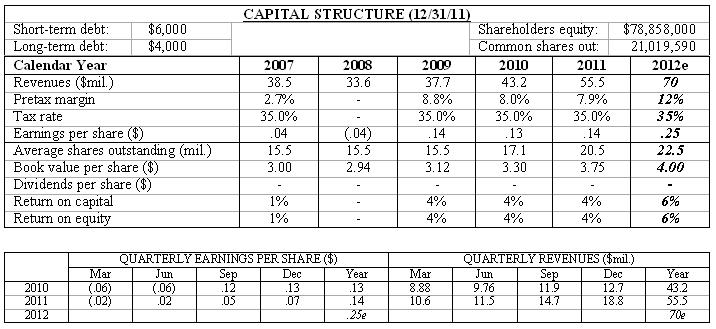
We estimate income will advance modestly in 2012 to $.25 a share (fully taxed).  Longer term, margins promise to expand meaningfully as volume grows.  Higher revenue per transaction could generate further leverage.  In 2-3 years income could attain $.75-$1.00 a share on sales of $125-$150 million. 

( Click on Table to Enlarge )


Wednesday, November 2, 2011

Ellie Mae ( Nasdaq - ELLI ) -- Let's Rewrite Those Mortgages

Ellie Mae (ELLI $5.25) reported excellent on target Q3 results.  Performance was affected by the acquisition of the company's largest competitor during the quarter.  Ellie Mae had to foot the bill for the new company's operating expenses.  But FASB accounting rules prevented it from recognizing the subscription income the company brought to the table.  The official accounting rules viewed that as a reduction in the selling price.  So revenues associated with the new business essentially were zero in Q3 while the corresponding expense came in at $1.2 million.  Earnings were understated by $.04 a share as a result.  Ellie Mae netted $.05 a share (fully taxed) in the period, nonetheless.  That was achieved despite the fact U.S. mortgage originations declined 20% year to year to a generational low.  Revenues from the company's pre-merger business advanced 23% to $14.7 million.  That figure was diminished, too, by Ellie Mae's ongoing program to convert customers from perpetual software licenses to a per-mortgage fee structure.  Upfront revenue is substantially higher on license sales.  That makes the deal attractive to banks in the current climate.  But income potential to Ellie Mae is greater over the long haul as the recurring revenue stream builds up.  An even greater windfall could develop if the mortgage market returns to a normal level of activity.

The HARP program could provide a lift in 2012.  That's the scheme the Obama Administration recently unveiled to help underwater borrowers refinance at today's lower rates.  Industry experts predict the new rules could generate 1.0 million successful mortgage refinancings over the next two years.  Currently, 50% of the market is controlled by approximately 20 giant banks.  Ellie Mae doesn't participate in that segment.  Those institutions use their own automation software.  With its recent acquisition the company has taken over about 60% of the remainder, though.  So an extra 300,000 deals could go the company's way between now and the end of 2013.  In theory, that could amplify revenues by $20-$30 million a year.

Assuming flat mortgage origination activity, we estimate 2012 revenues will advance nearly 40% to $70 million.  Approximately two-thirds of that is expected to be generated by the recently acquisition.  The balance could come from greater use by existing customers, and the addition of more revenue generating services per mortgage.  Margins are nearly certain to improve as the revenue from the acquired company starts to be reported, not just the expenses.  Some genuine operating leverage is possible, as well.  We estimate fully taxed earnings will advance more than 100% to $.25 a share.  A stronger showing is possible if the HARP program delivers a boost or the overall housing industry picks up.

We think the housing industry will improve in 2012.  Most economists have predicted rebounds in each of the past three years.  They now forecast further malaise.  That is the trend, so they might prove to be correct.  But American households have de-leveraged over the past few years.  Debt to income ratios are down.  There's tremendous pent-up demand to move for personal, business, or retirement reasons.  And the foreclosure overhang is winding down.  House prices probably won't surge.  But real estate activity has the potential to move sharply higher.  Each new mortgage is an opportunity for Ellie Mae.  The company already is well positioned to perform well under depressed conditions.  Income could fly if volume picks up.

In 2-3 years earnings could reach $.75-$1.00 a share.  Applying a P/E multiple of 20x to the low end of the range suggests a target price of $15 a share, potential appreciation of 185% from the current quote.

( Click on Table to Enlarge )


Thursday, October 13, 2011

Ellie Mae ( Amex - ELLI ) -- Automating the Mortgage Industry

Ellie Mae (ELLI $5.00) is the leading provider of software used by lenders to automate the mortgage origination process.  The company provides a wide range of products and services that enable lenders to enhance productivity, reduce costs, comply with regulatory requirements, improve accuracy, and connect directly with various funding sources and investment outlets.  Ellie Mae is the industry's largest independent software provider.  About 50% of all new mortgages written in the U.S. currently are produced by 20 mega-banks.  Those giants handle their technology needs internally.  The rest of the market is served by smaller banks and a host of mortgage brokers.  Ellie Mae focuses mainly on the banking segment (90% of sales), which has been gaining market share at the expense of mortgage brokers (10% of sales) since 2007.  They now generate 39% of all mortgages written, compared to 11% for brokers.  Total industry volume remains depressed, of course, so many banks have reduced personnel over the last three years despite their relatively better performance.  Demand for Ellie Mae's software has climbed as result as customers replace labor with technology to boost productivity.

A recent acquisition cemented Ellie Mae's industry leading position.  In mid-August the company purchased Del Mar Datatrac for $17.2 million in cash, plus $8.0 million in contingent payments.  Before the transaction Ellie Mae's technology was being used to originate 20% of all U.S. residential mortgages.  That figure is expected to reach 30% with the Del Mar acquisition.  Since the mega-banks account for half the total market Ellie Mae actually now holds 60% of its addressable market.  Reported earnings will be impacted by the combination over the next two quarters because GAAP accounting rules prevent the recognition of deferred revenue by an acquiring company.  Ellie Mae will be responsible for the associated cost of fulfilling the backlog, though, putting the squeeze on margins.  Once that obligation is worked off margins should revert to normal, then benefit from economies of scale.

A shift in pricing strategy is restraining near term profitability, as well.  Until two years ago Ellie Mae licensed its software at a fairly high upfront price, and earned additional income from software upgrades and  a variety of transaction fees.  Following the real estate crash the company switched to a success based model ("software as a service") where customers pay each time a mortgage closes, the exact amount depending on how much software is used.  Last year 29% of its customers employed the SAAS model.  By Q2 that figure had risen to 42%.  Within 2-3 years Ellie Mae hopes to convert 90% or more to that transaction based approach.  The reduction in upfront licensing fees is affecting short term profits.  But long term income will benefit from the enhanced recurring revenue stream.

Superior growth is likely even if the housing industry remains depressed.  Only 1% of all loans presently are produced 100% electronically.  Revenue per loan promises to expand as more elements are computerized.  Costs to the originating mortgage banks are likely to decline as a result of that greater productivity, even as the revenue to Ellie Mae expands.  Direct competition is scant, following the Del Mar purchase.  R&D spending is being maintained at elevated levels (25% of sales, enabling the company to enhance its competitive advantage while broadening its revenue potential. 

Mortgage activity could triple from current levels if it returns to the long term trend line.  Mainstream economists have predicted a housing market recovery in each of the last three years.  Now they've thrown in the towel, predicting further malaise in 2012.  Two factors make that unlikely.  First, there is a tremendous pent-up demand to move for job-related and retirement purposes.  After three years of price declines and foreclosures the market now has cleared in many parts of the country, making those moves possible at last.  And second, it's virtually certain the Federal Government will enact legislation allowing homeowners who are current on their loans to refinance at today's lower rates, even though they technically don't qualify due to income or collateral reasons.  A mammoth surge in mortgage activity could rise from the ashes next year and continue to climb well into the decade.

Any pick-up will reinforce demand among lenders.  Most already have cut staff to the bone.  Even servicing today's low level of activity is a strain without computer assistance.  Once the surge begins the rush to automate is virtually certain to accelerate.  With 60% of the market and the best technology available Ellie Mae is likely to be the prime beneficiary.

We estimate 2011 sales will advance a modest 16% to $50 million.  The Del Mar acquisition is likely to contribute little to the top line due to the backlog accounting rules.  Income may in fact decline 23% to $.10 a share (see "Accounting Notes") due to acquisition related costs, elevated R&D spending, stepped up marketing efforts, and 22% more shares outstanding.  The company went public in April, issuing 5.0 million shares at $6.00 apiece.  We estimate revenues will advance 40% in 2012 as the Del Mar acquisition kicks in, margins improve, and further market share gains are realized.  A stronger performance is possible if the mortgage market generally improves.  Our estimates assume a flat comparison with 2011.

In 2-3 years revenues could attain $125-$150 million as the industry rebounds.  Income could reach $.75-$1.00 a share as recurring revenue builds, revenue per loan expands, and R&D costs fall as a percentage of sales.  Applying a P/E of 20x to the low end of the range suggests a target price of $15 a share, potential appreciation of 200%.

( Click on Table to Enlarge )