Showing posts with label Image Sensing Systems. Show all posts

Friday, August 5, 2011

Image Sensing Systems ( Nasdaq - ISNS ) -- Not Shovel Ready

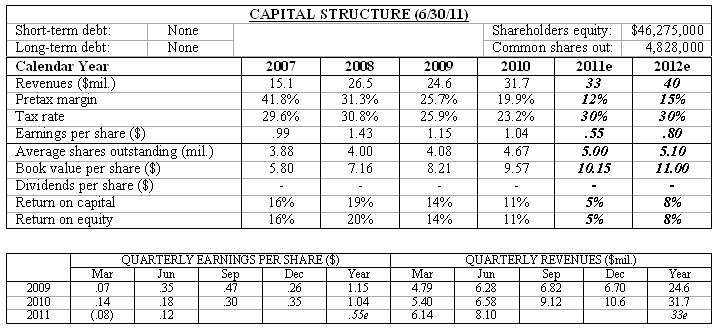
Image Sensing Systems (ISNS $8.15) reported lower than expected Q2 results.  The company is the leading provider of machine vision systems used to regulate traffic at intersections.  Those machines also are used in tunnels to spot fires, and along highways to report jam-ups and accidents.  Image Sensing produced stellar performance under its previous management team, which retired a few years ago.  The new line-up has overseen a steady downturn in earnings, albeit under difficult economic conditions.  Two acquisitions have delivered less impetus than projected.  One of those units produces traffic control systems that employ radar to count the vehicles lining up at red lights.  That approach works better in certain lighting conditions.  Image Sensing additionally purchased a license plate reading technology last year.  The company also has invested aggressively to develop international markets, primarily in Asia and Eastern Europe.  None of the initiatives have been especially rewarding to date.  For the quarter income dropped 33% to $.12 a share.  Sales were up 23% to $8.10 million but most of that was accounted for by acquisitions that weren't included in the year ago figure.

U.S. highway construction hasn't picked up as expected.  In every recession since the automobile was invented government spending on transportation infrastructure expanded as a way to boost jobs while getting useful projects completed.  When the Obama Administration took office in 2009 it touted expansive plans to invest in a plethora of "shovel ready" highway projects.  The last three summers have seen little headway, though.  Image Sensing has been facing macro-economic headwinds, as a result, amplifying its internal struggles.  A near term improvement appears unlikely.  We are reducing our 2011 full year earnings estimate 35% to $.55 a share, accordingly.

A new product, developed internally, could restore a bounce in the company's step.  The line is aimed at Image Sensing's core intersection control market.  It combines the company's machine vision and radar technologies into a single package to produce superior results at a reasonable price.  With the error rate virtually eliminated competition should become less significant, helping margins.  Attractive pricing also should help Image Sensing knock out indirect competition provided by loops that are buried under the roadway.  Those systems are cheap but are expensive to install and repair.

The shares are unlikely to do much in the meantime.  The new line is slated for introduction in Q1 of 2012.  If Image Sensing can rehabilitate its foreign business during the interim performance could post dramatic gains next year.  Value investors can realistically maintain positions with an eye towards tripling the stock price within 2-3 years.

( Click on Table to Enlarge )


Thursday, May 5, 2011

Image Sensing Systems ( Nasdaq - ISNS ) -- Follow-up Report

Image Sensing Systems (ISNS $12.00) reported poor Q1 results, consistent with the company's earlier announcement.  Sales rose 14% to $6.14 million.  A loss of $.08 a share was incurred.  Performance in China, which represents a huge opportunity, was far below internal targets.  Image Sensing's radar line produced unusually low sales levels, too.  That unit was acquired in 2009.  A final earn-out was paid in Q1 based on results through December.  Sales might have been accelerated into Q4 to ensure the maximum bonus was paid, leaving the cupboard bare in the March period.  A separate acquisition, Citysync, which makes license plate reading systems, also suffered in Q1 due to high costs.  Image Sensing is working to improve that unit's margins but some lingering effects are possible in upcoming periods.

Financial success hinges on the core machine vision line (Autoscope) over the coming year.  That technology remains the industry standard and a series of upgrades has broadened the potential market.  Image Sensing markets the intelligent intersection management system in the U.S. through Econolite, which packages the line in more comprehensive offerings.  Sales in North America have been affected by the economy during the past two years but Econolite has kept the business moving forward with an effective marketing effort.  Image Sensing declined to say that 15%-20% U.S. growth is a realistic target in 2011, but we can't see significant reasons why it isn't.

Image Sensing's direct sales activities are more of a question mark.  The company has been unable to make inroads in China despite years of trying.  Its two acquisitions are producing lackluster results.  Sales in Europe are okay but nothing to be excited about.  So it will be up to Econolite to save Image Sensing's bacon this year.  A new hybrid intersection product that combines machine vision with radar is rolling out of R&D at long last.  But that system probably won't generate a material impact until 2012.  We are maintaining our 2011 sales estimate at $35 million.  We are reducing our non-GAAP earnings estimate by 15%, though, to $.85 a share, to reflect the unanticipated rise in expenses.  Aggressive investors should exit the stock until either the problems are fixed or the new hybrid line proves it will become a success.  Patient investors can hold on because downside risk is limited by Econolite's involvement.  

( Click on Table to Enlarge )


Wednesday, February 23, 2011

Image Sensing Systems ( Nasdaq - ISNS ) -- Gets the Green Light

Image Sensing Systems (ISNS $14.00) reported excellent Q4 results, somewhat above our expectation.  Tighter government budgets at the state and local level prevented an even stronger performance.  Non-GAAP earnings advanced 35% to $.35 a share.  That figure would have $.03 a share higher, except Image Sensing had to pay a higher than expected earn out bonus to the former owners of CitySync, which was acquired during 2010.  Sales of CicySync's license plate reading system were stronger than predicted.  Earnings also were reduced by relatively high input costs at CitiSync.  Image Sensing inherited several supplier contracts, which will expire soon.  The company believes it can reduce those expenses by shifting to its regular suppliers.  Earnings benefited from a lower than expected tax rate, caused largely by the renewal of the R&D tax credit by Congress.  The amount for the full year was recognized in the period.  Earnings for the twelve months finished at $1.04 a share.  Sales finished at $31.7 million.

Earnings promise to advance sharply in 2011.  Sales are likely to reach $40 million, fueled by a full year's contribution from CiySync.  The license plate reading technology is proving to be Image Sensing's fastest growing category, as well.  Traffic management is likely to expand less rapidly, due to the budget deficits that are cropping up around the nation.  But underlying demand remains robust.  Congestion is building as the economy improves.  And computerized intersection management is cheaper alternative to new road construction.  A major new line that combines machine vision with radar is slated for introduction.  That line promises to propel Image Sensing's price performance advantage far beyond its competition, laying the groundwork for significant market share expansion over the next several years.

We estimate 2011 earnings will advance 30% to $1.35 a share.  Sustained above average gains are possible well into the decade as the license plate recognition line achieves wider adoption, and the hybrid product rolls out.  International potential remains huge, particularly in emerging markets.  Image Sensing already has sales offices in place in the Far East.

( Click on Table to Enlarge )


Saturday, January 15, 2011

Image Sensing Systems ( Nasdaq - ISNS ) -- Follow-up Report

Image Sensing Systems (ISNS $13.50) appears on track to report excellent on target Q4 results.  The company is the leading manufacturer of machine vision systems used in traffic management applications.  Cameras are mounted at intersections.  Images are fed into onboard computers, which dynamically change the lights to keep the cars moving efficiently.  Besides being more intelligent, machine machine systems cost less than conventional underground sensors ("loops").  Those products require the road to be torn up when they're originally installed or replaced.  Image Sensing's technology also is used on highways and in tunnels to report accidents, fires, and other emergencies. 

Results have stalled over the past two years due to budget pressures.  State and local governments account for most of the company's orders.  Image Sensing has responded by driving down costs and prices, improving performance, and gaining market share.  Two years ago Image Sensing acquired a maker of radar detectors, which work better than machine vision in poor lighting or bad weather conditions.  This year the company plans to launch a combination system that employs both radar and machine vision.  Image Sensing also purchased a license plate reading technology in 2010.  That remains a niche market at present but could be integrated as a standard feature over time.  Police and homeland security funding could supplement highway department outlays, helping things from a budgetary standpoint.

Foreign business varies from period to period.  But the long term trend is higher.  Image Sensing currently is strongest in the Far East and Eastern Europe.  Marketing efforts have been expanded in those areas and could lay the groundwork for accelerating gains in future periods.  For now, we estimate that financial performance will remain solid but unspectacular.  Income appears headed towards $.90 a share in 2010, down from $1.15 the year before.  Next year a rebound to $1.35 is possible as the new products kick in, international volume keeps rising, and overall U.S. demand improves modestly.

( Click on Table to Enlarge. )


Sunday, November 7, 2010

Image Sensing Systems ( ISNS - Nasdaq )

Image Sensing Systems (ISNS $12.50) is the leading provider of machine vision systems used in traffic applications.  The company's products are mounted at intersections to optimize traffic flow.  The technology is superior to underground sensors, which cost more to maintain because the entire road has to be torn up when mechanical problems occur.  The systems' ability to "see" and mathematically interpret the situation also speeds up response time.  Image Sensing additionally sells units for use in tunnels (to spot fires), along busy highways (accidents), and in a variety of other applications.  An acquisition last year added a complementary technology that relies on radar detection.  Poor lighting conditions sometimes confuse the machine vision software algorithms.  Radar provides a second tool for confirming where the cars are.  In the June quarter of 2010 Image Sensing purchased a provider of automated license reading systems, as well.  That line already enjoys a growing stand alone customer base, primarily for police and anti-terror applications.  The company hopes to generate further leverage by marketing it together it with its traditional traffic control business, creating more competitive differentiation and higher average selling prices.

Financial results have been under pressure due to the worldwide recession.  State and local governments have scaled back highway projects in the United States because of budgetary shortfalls.  International business has held up better, mainly as a result of new road construction in third world nations.  But the pace of that growth has been constrained, as well.  Overall sales dipped 7% in 2009 to $24.6 million despite a modest contribution from the acquired radar line.  Earnings narrowed 20% to $1.15 a share.  (See "Accounting Notes.")  Same store sales have been relatively flat so far in 2010, a good showing in light of the ongoing budget pressures.  Overall sales are poised to increase 22% to $30 million, bolstered by the two acquisitions.  Higher marketing, product development, and integration costs have prevented income from keeping pace, though.  Those efforts are laying the groundwork for market share gains in the future.  Meantime, though, full year earnings likely will decline again, this time by 22% to $.90 a share.

A major rebound could begin 2011.  Image Sensing has tooled up its direct sales operation in China and other Far East nations over the past three years.  That effort is bearing fruit as the level of highway construction continues to ramp up in those markets.  Sales to Eastern Europe are bouncing back, as well.  And U.S. business could take off if the funding issues are neutralized.  Traffic congestion could intensify if the economy recovers.  Image Sensing's technology provides a cost effective alternative to new construction by making existing roads more efficient.  The company's competitive position has improved dramatically over the past few years, since smaller operators have been unable to match Image Sensing's ongoing investment in marketing and new product development.  The combination of resurgent demand and superior products could lay the foundation for accelerating financial performance over the next several years.

We estimate 2011 income will improve 50% to $1.35 a share on a 33% gain in sales ($40 million).  Growth could be sustained at above average rates in subsequent years as sales to China and other international markets keep expanding, and Image Sensing's share of the North American market widens.  Higher average selling prices, made possible by combining the license plate reading and radar technologies with the core machine vision line, should generate further leverage.  In 2-3 years sales could attain $60 million to deliver earnings of $2.25 a share.  Applying a P/E multiple of 18x suggests a target price of $40 a share, potential appreciation of 220% from the prevailing quote.

(Click on table to enlarge)